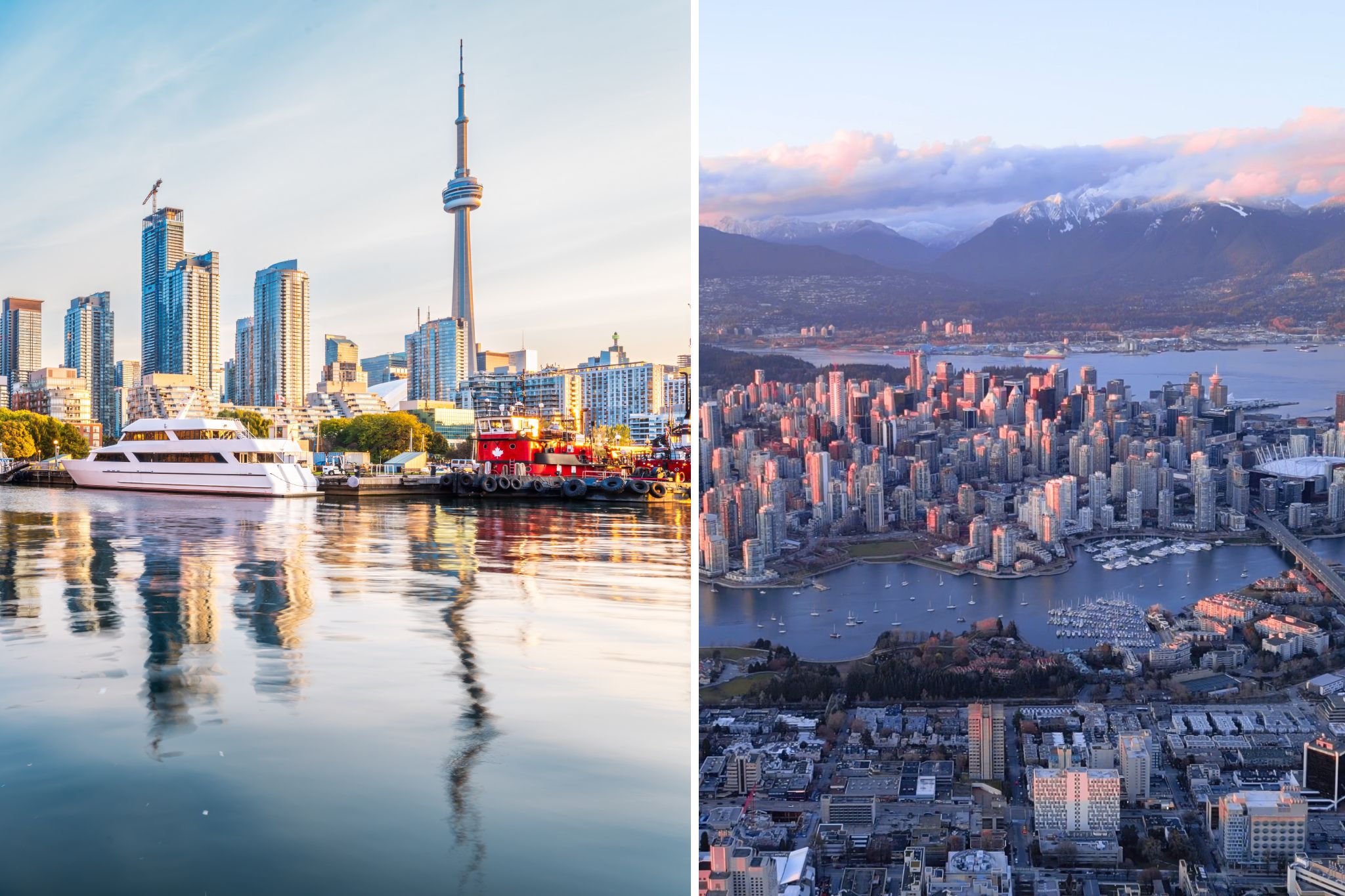
Toronto or Vancouver in 2026
Can You Still Afford to Buy a Home in Toronto or Vancouver in 2026?
The short answer is: it depends on what you're buying and who's buying it.
The longer answer involves real numbers that most housing market articles dance around. So let's just go there — what prices actually look like right now, what income you need to qualify, what the realistic entry points are by property type, and who the market is actually working for in 2026 versus who it isn't.
Where prices actually stand right now
Toronto
The MLS benchmark home price in the GTA hit $941,800 in March 2026 — down 7.4% year-over-year. That sounds like good news, and it is, relative to the 2022 peak. But it still puts the average Toronto home well out of reach for a single-income household earning a typical salary.
Breaking it down by property type:
Detached homes:averaging $1,151,700 — down 7.3% year-over-year
Semi-detached:averaging $1,008,246 — down 9.3% year-over-year
Freehold townhomes:averaging $931,740 — down 6.9% year-over-year
Condo apartments:averaging $620,479 — down 9.0% year-over-year, and still falling
Condo townhomes:averaging $739,365 — down 6.3% year-over-year
The condo market is taking the hardest hit. Investor demand — which drove much of the pandemic-era condo run-up — hasn't returned, and end-user buyers are highly price-sensitive. If you're buying in Toronto in 2026, condos give you the most negotiating power of any property type.
The broader market shift: new listings dropped 16.7% year-over-year in March while sales ticked up 1.7%. That tightening of supply is worth watching. The extreme buyer's market of late 2025 may not last.
Vancouver
Metro Vancouver's composite benchmark sits at $1,104,300 as of March 2026 — down 6.8% year-over-year but up slightly month-over-month.
By property type:
Detached homes:benchmarking at $1,854,800 — down 8.2% year-over-year
Townhouses (attached):$1,047,100 — down 5.7% year-over-year
Condo apartments:$706,700 — down 7.8% year-over-year, and the only segment still falling month-over-month
Vancouver has 14,774 active listings — 38% above the 10-year average — while sales track nearly a third below seasonal norms. That's a buyer's market by any definition. The sales-to-active listings ratio sits at 14.2%, just barely above the threshold for sustained downward price pressure.
What that means practically: sellers are negotiating. Incentives are appearing on new developments. Buyers who do their homework and aren't in a rush hold real leverage, especially in the condo segment.
What income you actually need to qualify
This is where the conversation gets uncomfortable for a lot of people. Let's be specific.
Toronto income requirements by property type
The mortgage stress test requires qualification at your contract rate plus 2%. With five-year fixed rates around 4.04% in April 2026, you're qualifying at roughly 6.04%. That has real consequences for what each income level can buy.
To buy a Toronto condo averaging $620,000:
Minimum down payment: $37,000 (5% on first $500K + 10% on remainder)
Approximate income needed: $110,000–$137,000 household
Monthly mortgage payment (at 4.04%, 25-year): approximately $2,970
To buy a Toronto townhouse averaging $930,000:
Minimum down payment: $68,000
Approximate income needed: $165,000–$185,000 household
Monthly mortgage payment: approximately $4,360
To buy a Toronto detached home averaging $1,151,700:
Minimum down payment: $115,170 (10% — new rules apply above $500K)
Approximate income needed: $200,000–$215,000 household
Monthly mortgage payment: approximately $5,100+
The median household income in Toronto is roughly $80,000–$97,000 depending on the source. At that income, the maximum qualifying mortgage sits around $330,000–$420,000. A typical condo in Toronto costs nearly double what the median household can qualify for on their own.
The math is harsh. Most first-time buyers getting into Toronto in 2026 are doing it with dual income, family help with a down payment, or both.
Vancouver income requirements by property type
Vancouver is even tighter.
To buy a Vancouver condo averaging $706,700:
Minimum down payment: $45,670
Approximate income needed: $125,000–$150,000 household
Monthly mortgage payment (at 4.04%, 25-year): approximately $3,290
To buy a Vancouver townhouse averaging $1,047,100:
Minimum down payment: $104,710 (10%)
Approximate income needed: $177,000–$195,000 household
Monthly mortgage payment: approximately $4,680
To buy a Vancouver detached home averaging $1,854,800:
Minimum down payment: $300,000+ (20% required above $1.5M)
Approximate income needed: $300,000+ household
This segment is functionally closed to most buyers without significant equity or family wealth
To afford an average Vancouver home across all property types, a household typically needs $177,000 to $210,000 in gross income. Vancouver remains the least affordable major city in Canada by almost every measure.
The double land transfer tax problem in Toronto
This one catches buyers off guard. Toronto buyers pay two land transfer taxes — one provincial, one municipal — that stack on top of each other.
On a $700,000 Toronto condo:
Ontario provincial LTT: approximately $8,475
Toronto municipal LTT: approximately $8,475
Combined: roughly $16,950
First-time buyers get a rebate of up to $4,000 on the provincial tax and up to $4,475 on the Toronto tax — so up to $8,475 back. But you still have to pay the full amount upfront at closing and receive the rebates afterward.
On a $1,000,000 Toronto home, the combined LTT — before first-time buyer rebates — can easily exceed $32,000. That's on top of your down payment, legal fees, home inspection, title insurance, and moving costs. Budget 3%–5% of the purchase price for closing costs in Toronto specifically, not the 1.5%–2.5% that applies in most other Canadian cities.
Vancouver buyers pay BC's property transfer tax, which runs 1% on the first $200,000 and 2% on the amount up to $2 million. First-time buyers get a full exemption on homes under $835,000 and partial relief up to $860,000. On a $700,000 condo, that's potentially $12,000 in tax you don't pay.
Who the market is actually working for in 2026
There are specific buyer profiles for whom Toronto and Vancouver make genuine financial sense right now — and profiles for whom the math doesn't work, regardless of how much they want it to.
It works if:
You're a move-up buyer with existing equity.If you bought a Toronto or Vancouver property five or more years ago, you're sitting on significant equity despite the recent price declines. Trading up within the same market is actually more attractive when prices are soft across the board — your next home is cheaper too.
You're a dual-income household earning $150,000+.The condo segment in both cities is accessible at this income level with a moderate down payment. It's not comfortable, but it's manageable.
You have substantial family help.Nearly 30% of Canadian first-time buyers receive financial help from family. In Toronto and Vancouver, that number is almost certainly higher. A gift of $50,000–$100,000 toward a down payment doesn't just reduce your mortgage — it changes your entire qualifying calculation.
You're buying a condo in a softer submarket.Some Toronto condo buildings and Vancouver condo complexes are down 10%–15% from their peak. For buyers with strong income and a 5–10 year horizon, those entry points look reasonable.
It's a stretch if:
You're a single-income household at median wages.The median Toronto or Vancouver household income simply doesn't qualify for a typical home in either city without extraordinary down payment savings or co-borrowers. This isn't a temporary problem — it's been structural for years.
You're buying a condo as an investment property.Condo investors in Toronto have been cash-flow negative for years. Falling rents plus higher mortgage payments at renewal plus condo fees adds up to a tough holding environment. The recovery thesis depends on a rebound that's currently estimated to be mid-2026 to 2027 at the earliest.
You're banking on near-term appreciation.Neither city is positioned for a rapid price recovery in 2026. Royal LePage forecasts Toronto and Vancouver prices falling another 3%–4.5% this year. Anyone counting on quick gains to justify stretching their budget is taking on real risk.
The honest case for buying anyway
Prices are down. Inventory is elevated. Sellers are negotiating. Interest rates, while not at pandemic lows, are meaningfully lower than their 2023 peak.
For buyers who plan to hold for seven or more years, the combination of softened prices and stabilizing rates creates a better entry point than existed at any time between 2020 and 2023. The stress test ensures you're qualifying at a conservative rate. If you've been saving through the rate hike cycle and your income supports the payment, waiting for prices to fall further is a bet on a market trajectory that no major forecaster is currently projecting.
The risk of waiting isn't just that prices stabilize. It's that new listing supply — which is already dropping in Toronto — continues to tighten while demand slowly returns. That's the setup for prices moving the other way.
Practical moves if you're serious about buying in 2026
Get a pre-approval before you start looking seriously.Not an online estimate — an actual pre-approval from a lender or broker who has reviewed your income and debt. The number will probably be different from what online calculators suggest.
Lock in a 120-day rate hold.Fixed rates have been creeping up on bond market pressure. A rate hold is free and protects you while you shop.
Budget closing costs separately from your down payment.In Toronto especially, closing costs are significant enough to derail a purchase if you've mentally lumped them in with your down payment savings.
Negotiate on condos specifically.This is the segment with the most price flexibility in both cities right now. Days-on-market are extended, inventory is high, and sellers know it. Offers below asking — with conditions — are being accepted at rates not seen in years.
Consider the outer 905 and Fraser Valley.If the core city numbers don't work, the surrounding markets are often 20%–35% cheaper for comparable property. The remote-work flexibility many people still have makes the commute calculation different from what it was five years ago.
Key numbers at a glance (April 2026)
Toronto Vancouver Benchmark home price $941,800 $1,104,300Average condo price $620,479 $706,700 Average detached price $1,151,700$1,854,800 Income needed (avg. home)$160,000–$197,000 $177,000–$210,000 Income needed (condo) $110,000–$137,000$125,000–$150,000 Year-over-year price change−7.4%−6.8%Market conditionsBuyer's market Buyer's market
Figures are based on March/April 2026 data from TRREB, GVR, and available broker data. Individual qualifying amounts vary based on debt, down payment, credit profile, and lender.
Published May 2026. Market data sourced from TRREB, Greater Vancouver Realtors, and publicly available broker reports. Always confirm current prices and qualifying amounts with a licensed mortgage broker or real estate agent before making any decisions.
